
And I thought Michael Bay’s “Armageddon” was stupid

Note: I originally posted this at komplexify!, so it should be read with tongue is firmly inserted in cheek. To be fair, however, I should point out that I’m only following in the worlds of Thomas Jefferson1:

Ridicule is the only weapon which can be used against unintelligible propositions.


I’m notoriously bad at keeping up-to-date with things.

For example, last month there was some kind of English hullabaloo that caught everybody in the world’s attention except mine. Based on some of the pictures I saw, specifically the one at right, I initially thought England was renouncing its official Anglican faith in favor of Pastafarianism, but apparently it was just another run-of-the-mill royal wedding (although one significantly more NSFW than the one I remember as a kid).

I also completely missed this year’s Star-Wars-Speech-Impediment-Appreciation Day, and the associated salutation of May the Fourth be with you! Plus, it would have been a great excuse to show this awesome image about where Mogwais come from:

But I tell you what… I’ll be damned if I’m going to miss out on The Apocalypse, no pun intended. Because according to Bible scholar and civil engineer Harold Camping, it’s happening this weekend!

Saturday, May 21, 2011, to be exact.

I, for one, do not want to miss the Rapture. I mean, can you imagine the kind of losers who will be left behind…?

Okay, okay, I’ll admit that the chick in the video was a little… how do we say?… batshit insane. But Harold Camping is not! That dude knows when Doomsday is coming, because he has a proof, dammit.

Two, actually.

The first proves conclusively that Judgment Day happens this year. The argument (paraphrased) is as follows:

  1. According to Genesis 41:32 and repeated later in both 2 Peter 3:8 and the movie Inception, “one day with the Lord is as a thousand years.”
  2. In Genesis 7, God told Noah that He’d destroy the Earth in 7 days.
  3. Seven Earth days later, in the year 4990 BC, God flushed the planet down the drain.
  4. But, obviously, God was also telling Noah that He’d destroy the Earth in 7 Lord-days, because in addition to being omniscient, omnipotent, and omnibenevolent, He’s also omniefficient.
  5. Therefore, we conclude that God also told Noah he’d destroy the Earth in 7000 Earth-years after 4990 BC.
  6. Let’s see: 4990BC + 7000 = 2011AD OMFG WE’RE GOING TO DIE!!!

Observant readers will note that this merely specifies the year, but not the actual date, of the impending Rapture. Indeed, given what the Bible says — But concerning that day and hour no one knows, not even the angels in heaven, nor the Son, but the Father only. (Matthew 24:36) — and the fact that the Bible’s word appear to be axioms in the proof above, you’d figure that would be that.

Well, Camping’s got another proof that actually nails down the date. (Suck on that, Jesus!) It’s a little more technical, but the abridged version appears here, courtesy of Phineas and Ferb.
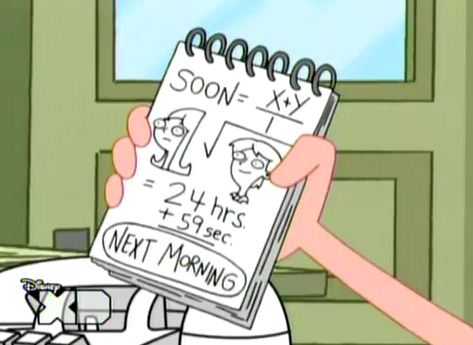
For a less abridged version, we need to establish a basic fact: some numbers in the Bible can convey Spiritual Truth. Most folks, for example, know that “666″ is “The Number of The Beast,” from which I think we can all naturally conclude that if you roll three sixes whilst playing Liar’s Dice, you are the AntiChrist and it is the duty of everyone around you to immediately stone you to death. (Less cynically, this is a well-known example of gematria, the psuedo-mathematical Hebrew tradition of assigning numerical values to words and phrases. Many contextual scholars believe that 666 is a coded insult directed to Emperor Nero (whose official name, in Greek, sums to 666) or, more generally, the Roman Empire after Nero.)

Another famous example is the number “3,” which the Bible describes in 1 Kings as being the ratio of a circle to its diameter. Once again, anyone who says otherwise, such as the ratio being closer to something like 3.14159, is clearly a heretic and should be put to the everlasting fire immediately.

Camping argues that the following numbers’ spiritual meanings should be similarly obvious:

  • “17″ is important… it signifies “Heaven.” As evidence, in Jeremiah, the titular hero buys a parcel of land for 17 shekels of silver after Jerusalem gets sacked by Babylon on the instruction of God, as a guarantee that at some point the children of Isreal would once again occupy Jerusalem. So, obviously, 17 means Heaven.
  • “23″ is important… it signifies “Destruction.” As evidence, look at the plague God unleashes on the children of Isreal when they get freaky with rival god Baal in Numbers 25: And those that died in the plague were twenty and four thousand. So, obviously, twenty…um…three.
  • “5″ is important… it signifies “Atonement.” As evidence, Camping notes that the redemption story in Numbers 3 involves 5 shekels apiece. As further evidence, Exodus 30 states that folks must give half a shekel as an offering to the Lord. And a half, is of course, 0.5. (…Well, only if you’re using a base 10 numbering system, which we’d better hope is divinely mandated.)
  • “10″ is important (whew!)… it signifies “Completeness.” As evidence, the Bible typically speaks of things like 10 coins or 100 sheep or 1000 years, which is especially interesting in that the last two things are not 10. They are products of 10s, of course, so let’s hope multiplication is divinely inspired too.
  • Products are important (whew!)… they tell stories. For example, in John 21 the disciples catch 153 fish, which symbolize those who will be saved at Judgment Day. Obviously, 153 = 3 \times 3 \times 17, so its the purpose of God (3) to bring the saved to Heaven (17). The extra 3 is because God really means it.

Now, the start of the Apocalypse occurs when Christ’s atonement (number 5) for mankind is finally complete (number 10) and folks get Raptured up to Heaven (number 17). Since the atonement began at the Crucifixion, it must therefore be completed in exactly

5 \times 10 \times 17 = 850 days after the Crucifixion.

Oh wait. The Universe didn’t end in AD 35 on account of the fact that John 21 hadn’t been written yet. Sorry… let’s try again.

What I meant to say was the start of the Apocalypse occurs when Christ’s atonement (number 5) for mankind is finally complete (number 10) and folks get Raptured up to Heaven (number 17)… and this time, God really means it (extra numbers for everyone!). Hence, Judgment Day will occur exactly

5 \times 5 \times 10 \times 10 \times 17 \times 17 = 722500 days after the Crucifixion.

But wait! Jesus was crucified in 33 AD, and now it’s 2011 AD, a total of 1978 years. Since each year consists of 365.2422 days (approximately), that’s a grand total of

1978 \times 365.2422 \approx 722449 days.

Moreover, given that Crucifixion occurred either before (John 19) or after (Mark 14, 15) the Passover meal (or assuming the infallibility of the Bible, both times — ouch!), it’s reasonable to put the actual date of the Crucifixion on the first Friday of April in 33 AD, which Camping calculates as April 1. (Apparently, The Journal of Theological Studies got it wrong.)

So, from April 1, 33 AD to April 1, 2011 AD is 722,449 days, which means that we’ve got 51 more days past April 1 before the Apocalypse comes. Now, let’s see…

April 1 + 51 days = May 21 OMFG WE’RE ALL GONNA DIE!!!

QED, sinners.

You can’t argue with that math, especially when it comes from an engineer, and especially especially an engineer who already has practice calculating the exact date of Armageddon. (Camping previously concluded it was scheduled for September 6, 1994. Oops. He must’ve forgotten to carry the 1 when he divided by Jesus.)

So there you have it: Doomsday is scheduled for Saturday.

I just hope it can wait until 8 pm… there’s a new Doctor Who that I’d like to catch before the end of time.


1. From a letter to Francis Adrian Van der Kemp dated July 30, 1816 denouncing the doctrine of the Trinity.

Posted in A puff of logic | Leave a comment

It’s time to ask yourself what you believe in

If you read the previous three-part story really, then you know that after a couple of decades of soul searching and intense thinking, I don’t believe in a God.

But what, exactly, do I believe? The short and simple version is based on two precepts:

  • There is no meaning of life, but we can find meaning in life.
  • A meaningful life is one inspired by love and guided by knowledge.

I’m not sure to whom first precept should be properly attributed, but the second belongs to Bertrand Russell.  What does this mean to me?

There is no meaning of life…

The universe, in all its immensity, from its cold expanses of emptiness to its lush green oasis of diversity here on planet Sol 3, can be well understood by science, from its testable hypotheses to the evidence it gathers in support (or against!) them.  The evidence from science suggests that, far from being the “center of the universe” (in its colloquial sense), humanity is just one of many little organisms clinging on to one particular chunk of rock hurling through space around one particular star, nestled quietly in a spiral sweep of one particular galaxy hurling its way through the inky blackness of void.

Given this, I don’t believe that any sort of supernatural agent(s) created the universe with humanity in mind.  Perhaps a little more generously, I don’t believe any agent capable of creating the entire vastness of the universe would have any interests whatsoever in lives of the members of the species Homo sapiens.

Life simply is.

Perhaps life is not so uncommon, flourishing on millions of planets across the universe; perhaps life is is rare, existing in brief spurts on a few isolated worlds here and there; perhaps life is unique to this one planet. In any case, it doesn’t matter.  We are alive and sentient here and now, and that should be wondrous enough!  We can do without the additional hypothesis that it all exists for the benefit or amusement of some external sentience.

As a consequence, I don’t believe in any religion, which Daniel Dennett loosely defines as a “social system whose particpants avow belief in a supernatural agent or agents whose approval is to be sought.”

More generally, I am typically skeptical of any claims to “mystical” or “divine” dualism in life.  For example, I don’t believe in mathematical Platonism: that the truths and concepts of mathematics exist “outside” the minds of human beings.  In contrast, I think mathematics exists only as a construct within the minds of humans.

Perhaps more germane to the topic at hand, I don’t believe in humans have an eternal, incorporeal soul that is the pristine distillation of their essence and exists independently of the physical universe.   Instead, I agree with Douglas Hostetler’s strange-loop concept of the soul, which very loosely identifies the soul with a person’s consciousness or sentience : a “high-level” description of person’s mental symbols, codified over a lifetime and distributed across the brain(s!!) of human beings.  There isn’t “true” self buried in the ether waiting to be whisked away once you’ve shuffled off this mortal coil — your true self is your mortal coil, pure and simple.

… but we can find meaning in life

If you read the leading paragraph in the previous section uncritically — blah blah cold emptiness blah blah clinging to a rock blah blah hurtling through space blah blah — you could be forgiven for assuming I’d have a nihilist point of view.  But you’d be wrong.

Just because there isn’t some externally imposed goal towards which all life is directed, or some divine yardstick by which all life is measured, it does not follow that life must needs be aimless or without merit.  We’re also social animals, and as a species have thus evolved innate predispositions for certain forms of altruism and ethics to help us survive together as a species.  But we’re also sentient and empathetic animals, and so we also feel a sense of moral obligation to bring happiness to and reduce the suffering of ourselves and others.  Hence, even without the benefit of a lawgiving Lord, humanity is already driven by a purpose: to ensure not only the survival of our future generations, but that the world they inherit is one that maximizes human happiness while minimizing human suffering.

Moreover, human beings are unique lifeforms (as far as we currently know) to have a collective memory and a social consciousness.   We remember our past through stories, artwork, song, and prose, and we honor the memories of those who contributed to the betterment of people while we vilify or expunge the memories of those who sought to make others suffer.  Hence,  those who contribute most to the cause of humanity can already achieve something like immortality without needing to posit a hypothetical divine Disneyland for the devout.

I think these ideas are well summarized by John Keating in Dead Poets Society:

To quote from Whitman, “O me! O life!… of the questions of these recurring; of the endless trains of the faithless… of cities filled with the foolish; what good amid these, O me, O life?”

Answer: That you are here.  That life exists, and identity.  That the powerful play goes on and you may contribute a verse.

That the powerful play goes on and you may contribute a verse.

What will your verse be?

A meaningful life is inspired by love

Here I take love to be the generalization of the previous idea: the human concept that embodies altruism and benevolence, as well as care and fondness for family and friends and the aesthetic appreciation of beauty.  In particular, a life guided by love is one that recognizes the intrinsic value and equal worth of all human beings and safeguards their fundamental rights and freedoms as sentient creatures.  At a minimum, these include the rights to seek happiness, to earn an education, to live in peace and in good health, and the freedoms of expression, of mind, and of association. A life inspired by love is one in which there is no us and them… there’s only us.

At its simplest level, this means the Golden Rule: treating every other person as you yourself would like to be treated.  It’s worth noting that this is not a uniquely Christian doctrine.  Teachers such as Zoroaster, the Buddha, Confucious, and others have espoused this virtue long before Jesus.  Indeed, Mahavira, the patriarch of the Jain religion, articulate an even higher bar than the Golden Rule:

Do not injure, abuse, oppress, enslave, insult, torment, torture, or kill any creature or living being.

I’m not sure its within the abilities of humans to live up to this, but it is certainly something to strive to.

In essence, life inspired by love is equivalent to living a moral life, where I’m using the definition of morality considered by generations of freethinkers, from Bertrand Russell to Sam Harris, namely, as principles of conduct to promote happiness and reduce suffering.  Note that this is contrast to the dictionary definition of morality as principles to differentiate between right and wrong, which assumes some “universal” standard of these concepts exists independently, which flirts with the very dualism concept I reject.  In practice, right and wrong are subject to the whims of the people in charge (as Russell said, “Those with the best poison gas will have the ethic of the future”), whereas human happiness and human suffering are much more objective measures.

A meaningful life is guided by knowledge

If we want to make any headway towards realizing this grand vision, it can only be through the deliberate application of intelligence — the unbridled acquisition of knowledge, the impartial application of logic and reason, and the unchallenged freedom of expression and dialog — not by sporadic bouts of preternatural revelation.

It is through the ongoing, human work of scientists and engineers that we have effective treatments for disease or technologies to ensure our safety and comfort.  It is through the continuous cycle of posing hypotheses, testing them, and re-evaluating them that humanity can begin to appreciate and understand vastness of our universe and inner workings, and it is an understanding untainted by delusions of self-importance or supernatural tests of ethics. It is by asking questions about our world and seeking answers to them, through application of reason and intellect together that we as a species now advance.

I don’t mean to short-change the humanities, by the way. I am a mathematician (and therefore a sort of proto-scientist), but I have always viewed what I do as art, and I do art for two main reasons.  First, art aims to inspire or challenge the viewer (or both!), and in either regard acts as a catalyst for thought, for inquiry, for discussion, which is nothing more than the accumulation and dispersal of knowledge!  I’ll quote John Keating once again:

We read and write poetry because we are members of the human race. And the human race is filled with passion. And medicine, law, business, engineering, these are noble pursuits and necessary to sustain life. But poetry, beauty, romance, love, these are what we stay alive for.

Second, art (and the humanities in general) allow mankind to maintain its collective memory: humanities ability to recall its past, to learn from its many painful mistakes, to contemplate its hard-earned wisdoms, and to appreciate its splendid diversity. It is through the images and music and words of artists and scholars that we can experience humanity’s past and share collectively visions of its future.  If science is what gives mankind an objective appreciation of the universe around us, it is through art we can translates it to a sublime, distinctly human one.

In any case, human intelligence and creativity are marvelous things, and nothing should be ever done to censor or handicap either.

Corollaries

Let me outline two consequences that I think follow from the two main precepts above.

First, I would suggest that the only moral form of government is a democratic one, one “by the people, of the people, and for the people.”  A proper government should establish equal justice, ensure peace, promote general welfare, and work to secure the rights and freedoms of its citizens.  That being said, it is the obligation of the citizens to work to ensure their government does just that; and should a government fail (say by stamping out the rights of its citizens, or ignoring the needs of the most impoverished) its citizens have the obligation to revolt from it and establish a new government.

Second, I would suggest that religion, in general, does not help humanity with either precept.  All religion purports to give an external meaning of life, a divine and unquestionable set of instructions to which all humans are meant to adhere.  Moreover, almost all regions devalue finding meaning in life, in the sense that most simply view this life, right here, right now, as merely a transitory phase to something else, something better.  Indeed, many religions (I’m looking at you, believers in the God of Abraham!) actively seek to belittle and disdain this so-called earthly existence as flawed and sinful and essentially unhappy!

As for living a life inspired by love (i.e. a moral one) and guided by knowledge (i.e. promoting free inquiry and expression), once again religion falls short.  Despite their pretensions to the contrary, almost no religion teaches its adherents to live a moral life.  Religions necessarily divide the world into the followers and the infidels, the saved and the damned, the enlightened and the foolish: by axiom they cannot assume every human as the same intrinsic value.  (And indeed, Christians cannot usually concede that human life has any intrinsic value; it’s only the magical soul that matters, not the bag of meat that encases it.)  Moreover, by perpetuating superstitions of cosmic sin and everlasting punishment, many religions actively work to be immoral, in that they work to increase human misery and deny human happiness (just consider the perpetuation of slavery, bigotry towards women and/or homosexuals, denial of birth control and reproductive education… and that’s just the Catholic Church).

Similarly, any “revealed” religion (yeah, I’m looking at you again God of Abraham) cannot support free inquiry and expression.  Facts and theories that contradict the divine edicts of the Creator must be suppressed or belittled, not investigated, and hence science and inquiry is stunted.  Ledgers of supernatural thought-crimes stifle art and prose, and hence expression is abridged.

Note that I am not saying that it is impossible for religious people to leave good, meaningful lives.  I would, however, argue that such lives are lead not because of the dogmas of the faith, but the humanity of the faithful.

Posted in A puff of logic | Leave a comment

Losing my religion, part 3

Madalyn Murray O’Hair  famously declared that “an agnostic is just an atheist without guts,” and that would be a pretty fair assessment of me through graduate school.

I had well articulated moral compass, a definite sense of what constituted a purposeful life, and a coherent set of tools to further investigate the workings of the universe and our place in it.  All of the things that religion had provided for me when I was a kid, were now provided by reason,  common sense, and an appreciation of a shared humanity. I simply didn’t need a God to make the universe work, but I was still unwilling to completely discount God’s existence either.  In particular, logic and reason could not disprove the existence of God, so that in and of itself said something… didn’t it?  Or does a purpose in life necessarily imply a purpose of life?  It’s a bit of cognitive dissonance I think all people not completely devoted to a dogma must experience.

Nevertheless, in graduate school, I devoted myself to learning more about mathematics.  I don’t just mean learning the tools and techniques of analysis and algebra and geometry and whatnot, however. Mathematics was a pristine human language: its tools the product of numerous contributions by different cultures at different times (continuing on to this very day!); its applications aimed towards understanding the human experience of the world.  As such, I spent time reading about the cultural roots of mathematics and the scientific applications of mathematics.

My mathematical training taught me to appreciate logic and rigor and to spot various logical fallacies, flaws, and statistical errors people often make when making an argument.  My reading about math history and ethnomathematics taught me to appreciate the diversity of human experience, and be mindful of dogmatic pitfalls.  And science?  Reading about science provided a coherent framework for understanding the natural world without recourse to the supernatural…

  • cosmology could explain the origins of the universe and the history of stars and planets;
  • geology could explain the tumultuous (and ancient!) history of the Earth;
  • evolution by natural selection could explain the vast diversity of life and its appearance of design;
  • biology and physics could explain the concept of the soul and the appearance of free will;
  • anthropology could explain the emergence of common ethics and morals;
  • and so on…

Bit by bit, what I read and learned chipped away at “the God of the Gaps,” making any kind of belief in “greater power” more and more irrelevant and therefore more and more unlikely.

In the meantime, I earned my doctorate, got married, and went off to work as a professor and mathematician.  The life of a working Joe, dominated as it is by work and bills and and schedules and mortgages, left little time to pontificate on these matters, and that’s pretty much where they stayed

…until I made decision in 2006 that had nothing to do with religion or God or spirituality.

One of the age-old questions in mathematics is whether one discovers it or creates it.  That is, do all mathematical truths and concepts  “exist” in universe in some real, albeit ideal  form, and humans merely reveal them with the tools of logic and proof in the same way that a paleontologist unearths the bones of long dead dinosaurs with a pick and brush?  Or is mathematics simply art, splashes of paint on the canvas of humanity’s collective mind that have no more permanence outside human existence than a faint fragrance carried on a breeze?

It’s a debate as old as mathematics itself, and there are compelling arguments in favor of either side.  For example, devising new definitions or ideas or isomorphisms sure feels like an act of creativity – flashes of insight or playful what-if’s — but investigating the consequences of these constructs sure feels like an act of discovery.  One argument in favor of creativity is that mathematical concepts aren’t bound to anything observed or connected to the world around us: simply choose your axioms and let your mind wander.  The counterargument, of course, is that mathematics — even the bits purposely designed to have no utility — always ends up describing the universe around us.

To me, after everything I had learned about the mathematics, this question had an obvious answer.  Just consider it from three perspectives:

1. The mathematical perspective. Simply consider the following pair of statements:

  • The “discovery” view — often called mathematical Platonism — has one helluva hypothesis, namely, that every mathematical concept, definition, and truth that every was or ever will be articulated already exists in some timeless, nonphysical, ideal state.
  • This hypothesis is completely irrelevant to how these mathematical truths are made available to people.  That is, the set of discoverable true mathematical statements under either worldview is 100% the same.

In particular, there is no mathematical reason to accept mathematical Platonism.

2. The practical perspective. The discipline of mathematics itself suffers under mathematical Platonism. Every new breakthrough in mathematics — be it the discovery of negative numbers, or imaginary numbers, or noneuclidean geometry, or the differential calculus, or transfinite arithmetic — has always, always been resisted (and actively campaigned against!) only by those who subscribe to a Platonist view.  Simply put, you can’t argue that there’s no such thing as a number “less than o” or “infinitely many lines parallel to a given line through a given point” unless you actually think those things already exist in some pristine form that can be damaged or corrupted.

3. The change of perspective.  The utility argument — that “the unreasonable utility of mathematics in describing the universe around us is evidence that mathematics exists independent of us” — is a tough statement to counter, but it also might be asking the wrong question.  The basic building blocks of mathematics — arithmetic and geometry — were built to model the most basic aspects of the observable world.  Is it not reasonable that a subject initially designed to model the universe around us might, in fact, model the universe around us?

But what about the “unreasonable” utility of mathematics?  Why, for example, does something as esoteric as the imaginary number, originally thought to have no real-world applicability, do so well in describing the processes of electric engineering?  Human beings are amazing pattern recognizers: it’s a survival trait we’ve evolved with.  The human brain is simply wired to find patterns and connections.  Is it not reasonable, rather than having humanity evolve to a better understanding of mathematics, it might be that mathematics evolves to the needs of humanity?  If anything, there’s no compelling argument either way here.

Taken together, these arguments cannot conclusively disprove the preternatural existence of “mathematics,” but they do show (1) there is no logical reason to believe in it, (2) there are practical reasons against believing in it, (3) and scientific alternatives to it being true…

… and so therefore, I don’t believe in mathematical Platonism.

But, I realized immediately, everything, everything about that previous argument applied to the existence of God:

  1. There is no logical reason to believe in God, in the sense that God is an “added hypothesis” that doesn’t serve to clarify anything, which was the conclusion that lead me to agnosticism.
  2. There are practical reasons not to believe in God, in the sense that such beliefs often do more harm to humanity than good.  I experienced this in a minor way by losing a friendship over a difference in dogma, but the world has experienced it over and over in a grander way.  Every advancement towards a greater, more caring, more happy humanity — the abolition of slavery, opportunities for greater education, equal treatment of women, of blacks, of homosexuals — has been opposed by the religious, those who self-identify the most as believers in God.
  3. There are scientific alternatives the existence in God, like those listed above.  Even more damning (no pun intended), there are several scientific reasons that actively argue against the existence of specific Gods, such as the God of the Abraham.

Taken together, these arguments cannot conclusively prove that God does not exist, but they provide overwhelming evidence in favor of the opposite.

…and so therefore, I don’t believe that God exists.

I was, finally, an atheist.


As a post script, I don’t mean to say I stopped there.  In the past five years, I’ve taken to the the wisdom of others, reading (hopefully with an open mind) better arguments from smarter folks than I acoss both sides of the aisle.  I’ve read books that argue for the existence of God (St. Thomas Aquinus, Karen Armstrong, Lee Strobel, William Craig) and books that argue against it (Christopher Hitchens, Bart Ehrman, Christopher Dawkins, Sam Harris). However, time and time again, I find the arguments in favor of God lacking, and the arguments against God ever more compelling.

But I still keep listening and learning, doing my part to love and respect others, and living this life, the only one I am certain of, was best as I know how.

Posted in A puff of logic | Leave a comment

Losing my religion, part 2

I mentioned last time that April is a good month to tell my deconversion story, but neglected to mention why.  It turns out that April is Mathematics Awareness Month, and it was my awareness of mathematics that made me eject God as an article of faith.

By the time I was in college, I had stopped identifying myself as a Mormon or even a Christian, but I still believed that there was a God that gave life a purpose, and that purpose was to love, help and respect one another.

But the thing I really remember about college, the thing that most profoundly affected who I am today, was my discovery of mathematics.  I had been good at math in grade school, but it never appealed to me. I had started college as an art major, partly because the notion of creating timeless beauty appealed to both my aesthetics and worldview and partly because I was good at it, but mostly because it was fun.  In contrast, nothing seemed less creative, less beautiful, and less fun than an algebra problem.

But thanks to a single professor who convinced me to try Calculus II, Calculus III, and General Topology, I discovered the sheer aesthetic joy of creative, pure mathematics.  I threw myself into its study, and eventually I had far more math credits under my belt than art credits, so I switched majors and ended up as the Math Department’s Distinguished Graduate in 1997.  (So enamored with the subject was I that I even had a year’s worth of graduate courses under my belt when I got my Bachelor’s Degree.)

I could go off for pages on the beauty and humanity of mathematics, and I probably will in the future.  (I frequently quip that I never changed my major, only my medium: instead of for the ears or eyes, I now do art for the mind.)  But what impressed me most about mathematics can be summarized in three things:

  1. Mathematics is an aesthetic experience.  It can move and inspire and therefore can speak to the soul.
  2. Mathematics is tool for discovering truth.  It can distinguish was is true from what one simply wants to be true.
  3. Mathematics is a human experience.  It’s the one language for describing the universe that all people agree on.

These concepts affected on my thinking about the nature of God in two profound ways.

First, these ideas naturally echoed my spiritual quest, which often involved identifying the common themes religions said about the universe and our role in it. What did mathematics, or logic in general, say about it?  I was in particular moved by the story of Laplace and Napoleon:

When Laplace presented him with a copy of the Mécanique céleste, his definitive work on celestial mechanics, Napoleon said “Though you have written this large book on the system of the universe, you have never even once mentioned its Creator.” Laplace simply replied, “I have no need of that hypothesis.”

It struck me that so many different systems of spiritual and religious thought agree (at least in very broad strokes) on the essential activities of a purposeful life — things like having empathy and goodwill for others, providing love and care for your family, and making the the world a better place for future generations, and so on — in spite of their differing deities and rituals and creation myths and whatnot. If that was the case, I figured, then why not simply accept those as the axioms to by which to live?

Did God exist? Did heaven exist? Those questions, which previously served to give my life direction and motivate my desire to be a good person, suddenly seemed obsolete. Religion could be viewed as specifying axioms from which one could “derive” the purpose of life. However, different religions produced different axioms, and irritatingly enough, it always seemed as though the axioms of any two different religions lead to an inconsistent system. Why not simply take their core of common theorems as use them as axioms to start with something we all agree as being true, and then derive its consequences?

Like Laplace, I found I had no need of another hypothesis.

Second, and more to the point, I could not fathom a God who would bless humanity with the faculties of knowledge and reason — faculties that simultaneously provided both a glimpse of divine inspiration and a means to make sense of terrestrial life — but would somehow predicate “eternal life” by boycotting those very faculties should they come in conflict with either an established dogma or an ill-defined “faith.”  Said differently, if there was a God, He gave mankind both a cognitive power to reason and an aesthetic ability to  appreciate reason for a purpose.  Blind faith wasn’t a virtue!  Quite the contrary!  It was about the single greatest insult against God one could muster.

Hence, by the time I was in graduate school, I felt confident that was a greater purpose to our lives (as evidenced by a nearly universal human prescription for various good acts and a call to, at the very least, respect one another) and that both reason and empathy were the tools we could use to work towards this purpose, but that the ultimate purpose was very likely unknowable.

If you’d asked me then, I’d say I was an agnostic, in that an explicit knowledge of God was unknowable, or (if I was feeling a little more argumentative) apatheistic, in that I felt the details of God were irrelevant to his purpose.

But really, I had relegated God to a hypothesis about existence that was either unneeded or irrelevant.  I was for all intents and purposes an atheist… I just didn’t have the guts to say it yet.

To be concluded.


Posted in A puff of logic | Leave a comment

Losing my religion, part 1

It seems fitting to start out this blog about atheism and freethinking by telling (briefly) the story about how I came to embracing both as my worldview.  April is also a good month for telling the story, but I’ll get to that next time.

I grew up in the Church of Jesus Christ of Latter Day Saints, better known as the Mormon Church. Whatever else you might know about mainstream Mormons, if I had to distill their mindset into one word, it would be family.  Everything about the Church is centered on strengthening your family, in the sense of both your immediate relatives and your surrounding community.  As a result, you can’t quite be a Mormon kid without the Church dominating a lot of your time.  There is Family Home Evening on Mondays, Home Teaching with dad on Tuesdays, church-affiliated Boy Scouts on Wednesdays, various intra- and inter-ward activities on Thursdays and Fridays.  If you were in high school, there was also Seminary Class every morning.  And, of course, there was actually honest-to-God church every Sunday.  None of that namby-pamby one-hour “mass” nonsense either, but a good solid three hours of church service, baby, each and every Sunday.

In short, when you join the LDS Church, you don’t just get a religion: you also get a large and fairly intimate family.  I visited homes of members and nonmembers with my dad when he went home teaching;. I was baptized by proxy for relatives of members.  I helped to collect fast offerings so that the Church could buy and store food for the hungry or down-on-their-luck.  Later, I was the hungry and down-on-our-luck when my dad was laid off as a draftsman and unemployed for several months, it was the Church that provided us with food and clothes until we got back onto our financial feet.

I enjoyed the Mormon Church life.

But more than that, I knew the Mormon Church was true.

How?  Two simple reasons, really. First, it had answers for the Big Questions: Why are we here?  What’s our purpose in life?  Why is their suffering?  How are we save?  I’m not going to get into the details of the Mormon answers to this questions, partly because it’s been a long time since I’ve given them any thought and I may misconstrue them now, but mostly because there’s an army of bicycle-riding, nametag-wearing LDS missionaries who will be more than happy to, trust me.  (Just be warned: once you join the Church, it’s almsot impossible to get out again.  Mormons are like God’s Mafia.)

Second, and most important, the Church’s answers to the Big Question rang true to me.  I had heard the still, strong voice of the Holy Spirit in those LDS doctrines, and it comforted me, and gave me direction and inspiration.  To me, the LDS beliefs, drawn from the Bible and the Book of Mormon and the various teachings of Joseph Smith, felt right and satisfying.  They felt true, and so they were true.

In hindsight, that’s not a very compelling argument, but for a kid it’s good enough.  In fact, it’s all that matters. I remember one day in junior high when I was talking with my friends over lunch about the nature of heaven.  My Catholic friend said that the purpose of heaven was a place for the righteous to give praise to God forever; to me, that made God petty and malevolent, creating an entire universe for no better reason than to produce a sea of sycophantic yes-men.  A Protestant friend (I don’t remember the particular Christian franchise) said that heaven was a place of infinite reward for righteous people; to me, that sounded awfully self-centered.  The Mormon answer seemed so much better: heaven was where your whole family could be together forever; that the bonds you formed on Earth could be preserved for all time and eternity and shared with God (and Mrs. God, too).  I remember the look of surprise with which this response was initially met by my buddies, but by the end of lunch both had conceded that mine was the most satisfying answer; one of them eventually converted over to Mormonism.

It’s great to have all the answers, and for a while, through the Church I did.

That certainty ended my junior year of high school, precipitated by a single, minor event: just one of those quick in-between-class shout-outs to see where we’d go after school.  I don’t remember what it was exactly, or even what I had said.  I only remember my friend Amy going suddenly stone cold.

“Are you Mormon?” she asked.

“Yep,” I said.

And that was the second-to-last time she ever spoke to me.

I had known Amy since the start of high school.  We’d become fast friends over our common interest in art and learning. We talked every day in class.

And then suddenly she acted as if didn’t know me, or indeed, couldn’t even see me.

Eventually I pulled her aside and asked the reason for the silent treatment, and her explanation was simple: her church taught her that Mormonism was a particularly dangerous and hell-worthy heresy.  And that was that.  I didn’t matter that I was a a similarly-souled artist, or good friend, or a decent human being; all that mattered was a difference of dogma.

I initially fumed over the bigotry of Amy’s church leaders and the stupidity of their assertions, as they seemed to fly in the face of a paramount pair of Jesus’ teachings: Do unto others and you would have other do unto you and Judge not, lest ye be judged.  I also bemoaned the unfortunate luck of Amy to have been born into such a misguided version of Christianity.

And that’s when it hit me.

Amy must have felt the exact same way about me.  Clearly, we couldn’t both be right.  Nevertheless, we both felt we were right, precisely because we been taught that our whole lives.

What was true for Amy and I was true of Christianity in general: there were many different sects, each of which asserting to know the true answers to the Big Questions, but their answers conflicted with one another.  It would be a matter of extraordinary luck if the religion you were born into was the true one.  How could you know for certain?  What if no one got it absolutely right?  How could you determine the truth?

These thoughts shook my faith severely.  I ruminated on this for months, praying for guidance. I believed that God could speak truth to us through the Holy Spirit, which manifested itself as our conscience, so I let my conscience guide me.  I spent the rest of my senior year finishing up Mormon Seminary, but I also made it a point to visit church services with friends, so that I could learn a bit about Catholicism and Lutheranism and Buddhism and any other -ism in which my friends believed.  I continued this in college, taking a class on comparative religions and another on non-Western worldviews.

Each time I would search for those aspects of their faiths that spoke to my conscience  as evidence of a central, underlying truth.  At the same time, I would discard the other bits — the competing narratives of creation, the disparate names for the creator(s), the laundry lists of various personal sins and thou-shalt-nots — as divisive and superficial trappings.

By the middle of college, I had developed the following spiritual worldview:

  • Heaven would only be worthwhile if you could enjoy it with your loved ones: your family and friends.
  • Such a heaven must be created by a God who valued those things: love, family, and friends.
  • If such a God had any requirement for entering such a heaven, it must surely be the dispensation to treat everyone as your loved ones (that is, with kindness, respect, support, and love while avoiding indifference, judgement, or cruelty) rather than strict adherence to some specific set of rituals, ceremonies, or dogma.

I found I no longer had the perfect answers to the Big Questions anymore, but I felt that the answers I did have were the true ones.  The purpose of earthly life? Learn to embrace love, empathy, and respect for others, even under hardship and duress.  I could still live a good and virtuous life and appreciate others for doing the same; moreover, by de-emphasizing any one particular creed or religious affiliation, I was giving other people the chance to do the same for me.

This was a spiritual plan of which God would certainly approve, and I felt comfortable in my faith again.

Of course, the thing is, the minute I to started cherry-picking the virtues of the Christian religion to live by –  such as deciding to embrace the Bible’s commandment to Love one another as an example of truth, but tossing out the Bible’s commandments to Keep slaves of those your conquer or Kill all homosexuals as perversions of truth — I’d admitted to everybody but myself that I didn’t need my religion’s God to find purpose in life.

As such, I was pretty much already an atheist… I just didn’t know it yet.

To be continued.

Posted in A puff of logic | Leave a comment

Introduction

Hi.

My name is Travis.  I’m a full-time mathematician and a some-time artist.  I’m also a haphazard blogger who has maintained a site called komplexify! in some form or another for over a decade. (Egads, am I really that old?)

I’m a nerd.  I’m a teacher.  I’m a dad.  I’m a husband.  I’m an aloha shirt hoarder.

I’m also something that may… disturb some of you.  Some of you may be appalled by it; some of you may never forgive me for it; some of you may find it incomprehensible. And, of course, some of you will not be surprised in the least.

I’m a member of the most distrusted and despised minority group in modern America.

It’s the group about which then-Vice-President George (Dubya’s Dad) Bush declared “I don’t think [they] should be considered as citizens, nor should they be considered patriots.”1 More recently, a 2006 poll conducted by the University of Minnesota2 (and more or less backed up by the Pew Research Center) ranked them as the Number 1 group when it comes to “agreeing not at all with my vision of American society” — at 39.6%, compared to the next worse offenders (Muslims) at 26.3%.  The same poll also shows that almost 1 out of every 2 Americans would disapprove of letting their kid marry anyone belonging to this group (47.6%), while the odds drop to about 1 out of 3 if the proposed spouse-to-be is a Muslim (33.5%), and 1 out of 4 if black (27.2%).

It’s time for me to come out of the closet.

No, not that closet.

I’m not gay, although I feel compelled to point out in Seinfeldian fashion: “not that there’s anything wrong with that.”  There’s nothing wrong with homosexuality, on the simple and utterly obvious fact that there’s nothing wrong with love… you fall into it with whoever you fall into it with.  Nevertheless, I am not gay.  One need only observe my complete and utter lack of fashion sense (Hawaiian T-shirts and Doc Martens everyday?  Really?) and unhealthy fascination with Karen Gillan to determine this.

No, I bear the scarlet letter.

No, not that scarlet letter.

I’m not an adulterer.  The missus could do far better than me, and I am ever grateful to her for being my best friend.  Plus, I’d hate to have to deal with that greasy host guy on Cheaters.. blech.  (Love you, honey!)

No, I’m worse than that, too.

The Out Campaign: Scarlet Letter of Atheism I’m an atheist.

(Huh.  I guess it was that scarlet letter after all.)

The mere mention of the “A” word caused a bit of strife when I posted this very introduction at komplexify! and probably cut my loyal readership in half.  (Thanks to the three of you that still remain.)  The following comic (from Pharygula) pretty much sums up the general reaction to the word:

What is so ghastly about that particular word?

Believe it or not, being an “atheist” does not automatically make one some amoral, nihilistic, Satan-worshiping, God-hating, baby-eating liberal.  Well, maybe the “liberal” bit, but all the other claims are just plain false.  I believe in morality, and I pretty sure have a fairly accurate moral compass, and I’m damn sure its better adjusted than, say, the ones used by the upper echelon of the Catholic Church.  I definitely am not some grim nihilist, but instead enjoy  a joie de vivre that emphasizes the profound  beauty of nature and knowledge and friends and family.  I obviously don’t worship Satan, on the grounds that I don’t believe Satan exists.  Similarly, I don’t hate your God for precisely the same reason.   And finally, I don’t eat babies, because they’re fatty and a bit hard to chew.

And yet the very word “atheist” conjures up all those ghastly associations and more, although I’m not exactly sure why.  Sure, there are less horrifying synonyms out there — nontheist or nonbeliever or agnostic (which I once heard humorously defined as “atheist without guts”) — but even they still bear the stigma of atheism.  The requisite insidious connotations are particularly paradoxical when one considers that the word “atheist” (or its more palatable synonyms) shouldn’t even exist. There isn’t a word for people who aren’t plumbers, or people who don’t play the lottery, or people who who don’t believe in astrology, or ghosts, or goblins, or unicorns, or whatever else. Why is there a word for people who don’t believe in deities?

I mean, you yourself don’t believe in most of the deities that other cultures have embraced (and perhaps still do).  You believe not in Adamas (the Gnostic creator god) nor Baal (the Semetic fertility god) nor Cakresvari (the Jain learning god) nor Devaki (the Hindu mother goddess) nor Enki (the Mesopotamian creator god) nor Faraguvol (the Haitan creator god) nor Ganaskidi (the Navajo harvest god) nor Hao (the Ethiopian creator god) nor Ilmatar (the Finnish creator god) nor Jupiter (the Roman high god) nor Kuan Ti (the Taoist war god) nor Loki (the Norse mischeif god) nor Mahamantranusarini (the Buddhist guardian god) nor Nuandu (the Celtic war god) nor … nor Xochiquetzal-Ichpuchtli (the Aztec fertility goddess) nor Yum Cimil (the Mayan death god) nor Zues (the Greek high god).  Some of these gods you may not know (like the Buddhist physician god Survarnabhadravimalaratnaprabhasa); other gods you discount as myth or story (like the Norse god and frequent Avengers team-mate Thor), but in any event your lack of belief in them is pretty much par for the course.  As Richard Dawkins said, “We are all atheists about most of the gods that societies have ever believed in. Some of us just go one god further.”

I think, however, the problem is that most folks equate a-theist with anti-religious and, more particularly, anti-everything-I-believe-in.  Perhaps this is precisely because such folks have been brought up their whole life to believe in some form of Magical Sky-Man, and they are simply unable to even conceive of any other worldview.  I sympathize with this idea: being an atheist means you reject the God Hypothesis, but that in turn means you are likely to reject many of its corollaries, such as The Afterlife, The Soul, The Divine Purpose of Life, Divinely Arbitrary Moral Law, and, of course, the accompanying Instruction Manual (also called the “Holy Text”).  If you toss out those, what do you have left to believe in?

Well, lots, actually. “A lack of belief in deities,” the dictionary definition of atheism, is usually a starting point to other worldviews.  For example, by ceasing to worry about the whims of an inscrutable Creator and the imagined pains of eternal punishment, atheists can devote their energy to the concerns of flesh-and-blood human beings right here, right now, a worldview loosely called humanism.  Being free of ancient dogma and superstition means that atheists are not prisoners of divine thoughtcrime, and instead are free to question and ponder anything without authoritarian prohibition, a worldview called freethought.  Without the supernatural to explain away the universe by magic, atheists typically embrace rationalism and skepticism; moreover, they can find joy and contentment in reason and science.  I don’t mean to suggest that all nonbelievers share some common Official AtheistTM vision of the universe. Rather, the point I wish to make is that the universe still makes perfect sense and is still every bit as wondrous and full of meaning even without the default three-word-answer of “God did it.”

This is more or less the purpose of A puff of logic.

This is a place for me to put down in written form my thoughts and experiences about my particular understanding of atheism, and how I came to it by degrees from diligent Mormonism to general cherry-picking ecumenicalism to “I believe in faith, not religion” agnosticism to finally admitting and embracing atheism.  I’m not explicitly looking to convert anyone, although I hope to open some eyes and/or minds here and there.  I’m really just looking to articulate my thoughts about “the Ultimate Question(s)” of Life, the Universe, and Everything (anyone worth their salt already knows The Answer, of course) and, like any good mathematician, justify them as much as possible.   So I guess this is really an exercise for me, but who knows?  Maybe it will generate some discussion here or there. Maybe I’ll convince you of the wisdom of my ways, or conversely, maybe you’ll convince me of the error of mine.

I feel compelled to comment on why I’m keeping these essays here rather than at the main komplexify! page.  Am I really so ashamed of my worldview that I need to hide it off the beaten URL?  No… far from it.  Unshackling my mind from years of ingrained dogma has given me a profoundly different and wonderfully invigorating understanding of the universe around us.  To paraphrase Nathaniel Hawthorne in the Scarlet Letter, I had not known the weight until I felt the freedom.

Unfortunately, no matter how tactfully or rationally I approach the subject, what I expect to write about here — atheism as a fulfilling, valid worldview — is going to be deeply offensive, if not downright heretical, to a nontrivial subset of readers.  Add to this the fact that the only way I know how to discuss things is with a balance of academic erudition and juvenile fart jokes, I will offend someone.  That’s just not the point of komplexify!, which is supposed to be light and airy and, well, dumb.  It’s an excuse to try my hand, however feebly, at wit and humor.  It’s a place to share stories about my kids with far-flung family members. It’s a place to share interesting tibdits of mathematical inanity.  It’s not a place to hunker down on deep (or deeply offensive) philosophical stuff.

More to the point: it is an unfortunate fact that the stain of atheism does not taint just the person who professes it, but it bleeds over to their friends and loved ones.  If you have questions about my worldview, I will be happy to answer them as best I can; if you wish to debate a point of contention, I shall endeavor to be a worthy opponent; and if all you can muster is a tsunami of condemnation, I am prepared to weather the storm.  But not my family, not my friends, not my colleagues.  Me.  I do not wish for anyone to be the collateral damage of the ill-will my personal non-belief invites.  Keeping this site distinct and removed from the other will hopefully minimize this.

I shall close this introductory post with a passage from Douglas Adams’ The Hitchhiker’s Guide to Galaxy that I have committed to memory, from which this site gets its name and, hopefully, its sense of humor as well.

Now it is such a bizarrely improbably coincidence that something so mindbogglingly useful [as the Babel Fish] could have evolved purely by chance that some thinkers have taken it was the final clinching proof of the NON-existence of God.

The argument goes something like this: “I refuse to prove that I exists,” says God, “for proof denies faith, and without faith I am nothing.”

“But,” says Man, “the Babel Fish is a dead giveaway, isn’t it?  It proves you exist, so therefore by your own arguments, you don’t.  Q.E.D.”

“Oh dear,” says God, “I hadn’t thought of that,” and promptly vanishes in a puff of logic.

“Oh that was easy,” says Man, and for an encore goes on to prove that black is white and gets killed at the next zebra crossing.


1 Madylin O’Hare’s history of the remark

2 Read the paper by Edgell, Gerteis, and Hartmann

Posted in A puff of logic | 2 Comments